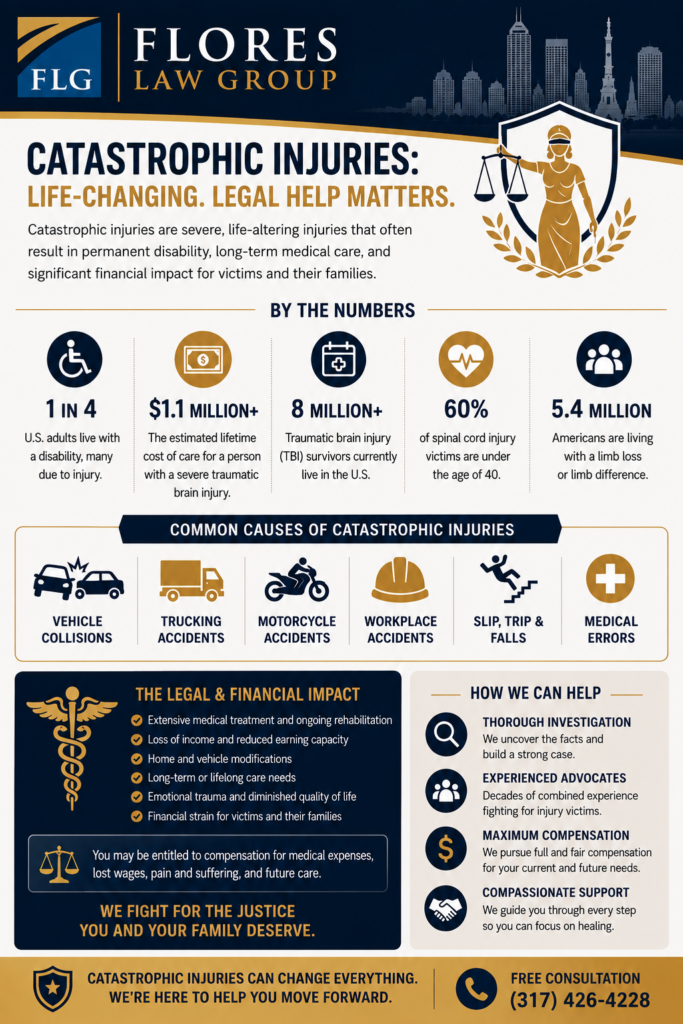
Catastrophic injuries permanently change a person’s life. Unlike less severe injuries that heal with time, catastrophic injuries often result in long-term or permanent disability, loss of independence, and the need for ongoing medical care. For victims and families in Indianapolis, these injuries bring not only physical challenges but also emotional strain and significant financial pressure.
At Flores Law Group, our firm represents individuals who have suffered life-altering injuries due to negligence. Catastrophic injuries frequently arise from serious accidents, including motor vehicle crashes, workplace incidents, and medical errors. In many cases, victims are suddenly faced with overwhelming medical decisions, uncertainty about the future, and questions about how they will support themselves or their families.
Our Indianapolis catastrophic injury attorneys understand that these cases require a different level of attention and planning. Compensation must account not only for immediate medical expenses but also for long-term care, lost earning capacity, and the lasting impact on quality of life. Families may need support for years or even decades after the injury occurs.
Flores Law Group is committed to helping catastrophic injury victims and their families pursue compensation that reflects the full scope of their losses. Through careful investigation, expert coordination, and personalized legal strategies, our firm works to protect the rights of injured individuals and help them move forward after a devastating injury.
What Is Considered a Catastrophic Injury?
A catastrophic injury is generally defined as an injury that results in permanent or long-term impairment, significantly limiting a person’s ability to live independently or earn a living. These injuries often require extensive medical treatment and ongoing care, and their effects are felt for the rest of the victim’s life.
What distinguishes a catastrophic injury from other personal injuries is the severity and permanence of the harm. Victims may lose physical mobility, cognitive function, or the ability to perform basic daily tasks without assistance. In many cases, individuals are unable to return to their previous occupations or maintain the same quality of life they enjoyed before the injury.
Examples of injuries commonly considered catastrophic include:
- Traumatic brain injuries, affecting cognition, memory, and behavior
- Spinal cord injuries, resulting in partial or complete paralysis
- Severe neck injuries, causing chronic pain or neurological impairment
- Multiple or complex fractures, leading to long-term disability
- Amputations or severe nerve damage, limiting physical function
Catastrophic injuries often place enormous strain on families. Loved ones may become caregivers, homes may need to be modified for accessibility, and long-term medical planning becomes a necessity rather than an option. The financial impact can be just as significant as the physical harm.
At Flores Law Group, our Indianapolis catastrophic injury attorneys help victims and families understand how the law recognizes these injuries and the compensation that may be available. Our firm focuses on building cases that reflect the full, lifelong impact of a catastrophic injury.
Types of Catastrophic Injuries We Handle
Flores Law Group represents Indianapolis clients who have suffered a wide range of catastrophic injuries. While each case is unique, these injuries often share common characteristics, including permanent impairment, extensive medical needs, and lasting effects on daily life. Our firm handles catastrophic injury cases involving both physical and neurological harm.
Some of the primary types of catastrophic injuries we handle include:
- Traumatic brain injuries, which may affect memory, reasoning, personality, and emotional regulation
- Spinal cord injuries, leading to paralysis or loss of sensation
- Severe neck injuries, often involving nerve damage or limited mobility
- Serious orthopedic injuries, including complex fractures and joint damage
Each of these injuries presents unique medical and legal challenges. For example, traumatic brain injuries may require ongoing cognitive therapy, while spinal cord injuries often involve long-term mobility assistance and specialized care. Neck and orthopedic injuries can also lead to chronic pain and permanent functional limitations.
At Flores Law Group, our Indianapolis catastrophic injury attorneys take the time to understand how each injury affects our clients’ lives. By tailoring legal strategies to the specific injury involved, our firm works to pursue compensation that supports long-term recovery and stability.
Common Causes of Catastrophic Injuries in Indianapolis
Catastrophic injuries often result from sudden, high-impact events that cause severe trauma to the body or brain. In Indianapolis, these injuries frequently occur when individuals are exposed to dangerous conditions or negligent behavior beyond their control. Understanding the common causes of catastrophic injuries helps victims and families recognize when legal action may be appropriate.
Some of the most common causes of catastrophic injuries include:
- Car accidents, particularly high-speed collisions and multi-vehicle crashes
- Truck accidents, where the size and weight of commercial vehicles increase injury severity
- Motorcycle and pedestrian accidents, which leave victims with little physical protection
- Construction and workplace accidents, involving falls, machinery, or electrical hazards
- Medical malpractice, such as surgical errors or delayed diagnosis
- Defective products, including unsafe equipment or medical devices
Motor vehicle accidents are a leading cause of catastrophic injuries in Indianapolis. Collisions involving trucks, motorcycles, or pedestrians often result in traumatic brain injuries, spinal cord damage, or multiple fractures. Workplace accidents, especially on construction sites, also account for many catastrophic injuries due to falls from heights or heavy equipment failures.
Medical negligence and defective products can also cause catastrophic harm, particularly when injuries affect vital organs or the nervous system. In these cases, victims may suffer irreversible damage before the problem is identified.
At Flores Law Group, our Indianapolis catastrophic injury attorneys carefully examine how an injury occurred and what factors contributed to its severity. By identifying the underlying cause, our firm can determine who may be held responsible and pursue claims that reflect the full impact of a catastrophic injury.
How Catastrophic Injuries Affect Victims and Families
The effects of a catastrophic injury extend far beyond the initial medical emergency. Victims often face permanent changes to their physical abilities, independence, and overall quality of life. For families in Indianapolis, these injuries bring emotional strain, financial stress, and the need for long-term planning.
Many catastrophic injury victims experience chronic pain, limited mobility, or cognitive impairment that affects daily activities. Tasks that were once routine, such as working, driving, or personal care, may require assistance. The emotional impact can include anxiety, depression, and frustration as individuals adjust to a new reality.
Related: Can Family Members Seek Compensation After a Catastrophic Injury?
Families are also deeply affected by catastrophic injuries. Loved ones may take on caregiving responsibilities, reduce work hours, or leave their jobs entirely to provide support. Homes may need modifications for accessibility, and long-term care arrangements may be required.
The financial consequences can be significant. Catastrophic injuries often involve:
- Extensive medical expenses, including surgeries and rehabilitation
- Loss of income, when victims cannot return to work
- Long-term care costs, such as in-home assistance or specialized facilities
- Emotional and psychological impact, affecting the entire household
At Flores Law Group, our Indianapolis catastrophic injury attorneys understand the far-reaching effects these injuries have on victims and families. Our firm works to pursue compensation that addresses not only immediate medical needs but also the long-term challenges that accompany a catastrophic injury.
Medical Treatment and Long-Term Care Needs After a Catastrophic Injury
Catastrophic injuries often require immediate, intensive medical treatment followed by months or years of ongoing care. For victims in Indianapolis, recovery is rarely a linear process. Many individuals face a lifetime of medical needs that must be carefully planned for and supported through appropriate compensation.
Initial treatment after a catastrophic injury typically involves emergency care, surgeries, and hospitalization. Once a patient is stabilized, the focus often shifts to rehabilitation, which may include physical therapy, occupational therapy, speech therapy, or cognitive rehabilitation. These services are critical to maximizing recovery and helping individuals regain as much independence as possible.
Long-term care needs after a catastrophic injury may include:
- Ongoing medical treatment, including follow-up surgeries or specialized care
- Rehabilitation services, often lasting months or years
- Assistive devices, such as wheelchairs, braces, or communication aids
- Home modifications, including ramps, widened doorways, or accessible bathrooms
- In-home care or assisted living, depending on the severity of the injury
In many cases, victims require coordination among multiple healthcare providers and specialists. Life care planning is often necessary to estimate future medical needs and associated costs. Without proper planning and compensation, families may struggle to afford the care their loved one requires.
At Flores Law Group, our Indianapolis catastrophic injury attorneys work closely with medical professionals and life care planners to understand the full scope of our clients’ long-term needs. This information allows our firm to pursue compensation that reflects not only current treatment but also the lifelong care required after a catastrophic injury.
Who Can Be Held Liable for a Catastrophic Injury?
Catastrophic injuries are often the result of negligence by one or more parties. Identifying who can be held legally responsible is a critical step in pursuing compensation that reflects the full impact of a life-altering injury. In Indianapolis, liability may extend beyond a single individual or company, depending on how the injury occurred.
Parties that may be held liable for a catastrophic injury include:
- Negligent drivers, in car, truck, motorcycle, or pedestrian accidents
- Employers or contractors, in workplace or construction-related incidents
- Property owners, who fail to address dangerous conditions
- Medical providers, in cases involving medical malpractice
- Manufacturers or distributors, when defective products cause harm
In many catastrophic injury cases, multiple parties share responsibility. For example, a truck accident may involve a negligent driver, a trucking company, and a maintenance provider. A construction accident may involve contractors, subcontractors, and equipment manufacturers. Identifying all responsible parties is essential to maximizing compensation.
Liability determination often requires detailed investigation, including accident reconstruction, review of safety records, and expert analysis. Insurance companies may attempt to shift blame or minimize responsibility, making thorough preparation essential.
At Flores Law Group, our Indianapolis catastrophic injury attorneys conduct comprehensive investigations to identify every party who contributed to an injury. By holding all responsible parties accountable, our firm works to pursue compensation that supports long-term recovery and financial stability after a catastrophic injury.
Proving a Catastrophic Injury Claim in Indianapolis
Proving a catastrophic injury claim requires more than showing that an accident occurred. Because these injuries involve permanent or long-term impairment, victims must demonstrate not only negligence but also the severity, permanence, and future consequences of the injury. This makes catastrophic injury cases more complex than standard personal injury claims.
To establish a catastrophic injury claim in Indianapolis, it is generally necessary to show:
- A duty of care existed, such as a driver’s duty to operate safely or an employer’s duty to maintain a safe workplace
- That duty was breached, through negligent or unsafe conduct
- The breach caused the catastrophic injury, not just a temporary condition
- The injury resulted in long-term or permanent damages, affecting the victim’s life and livelihood
Medical evidence plays a central role in these cases. Detailed medical records, diagnostic imaging, and treating physician opinions help establish the nature and severity of the injury. Expert testimony is often required to explain how the injury will affect the victim’s ability to work, live independently, and perform daily activities.
Life care planners and vocational experts may also be involved. These professionals help project future medical needs, ongoing care costs, and the impact of the injury on earning capacity. Their analysis is critical in demonstrating the true financial consequences of a catastrophic injury.
At Flores Law Group, our Indianapolis catastrophic injury attorneys work with qualified experts to build strong, evidence-based cases. By clearly demonstrating the lifelong impact of a catastrophic injury, our firm works to pursue compensation that reflects the full scope of our clients’ losses.
Compensation Available in Catastrophic Injury Cases
Catastrophic injuries often result in extraordinary financial losses that extend far beyond immediate medical bills. Victims in Indianapolis may require compensation that supports them for decades, not just during the initial recovery period. A successful catastrophic injury claim seeks to address both present and future needs.
Compensation available in catastrophic injury cases may include:
- Medical expenses, including surgeries, rehabilitation, and future treatment
- Long-term care costs, such as in-home care or assisted living
- Lost wages, when victims are unable to return to work
- Loss of earning capacity, reflecting reduced or eliminated future income
- Pain and suffering, accounting for physical pain and emotional distress
- Permanent disability or disfigurement, including loss of independence
In cases involving fatal injuries, surviving family members may pursue wrongful death damages under Indiana law. These damages may include funeral and burial costs, loss of financial support, and loss of companionship and care.
Insurance companies often attempt to minimize compensation by disputing the extent of injuries or future care needs. Because catastrophic injury claims involve large damages, they are frequently contested aggressively.
At Flores Law Group, our Indianapolis catastrophic injury attorneys take a comprehensive approach to evaluating damages. Our firm works to understand the full impact of a catastrophic injury and pursue compensation that supports long-term stability, care, and quality of life.
How Flores Law Group Helps Catastrophic Injury Victims in Indianapolis
At Flores Law Group, our firm is dedicated to helping individuals and families in Indianapolis who are facing the life-altering consequences of catastrophic injuries. These cases require more than standard legal representation. They demand careful planning, detailed investigation, and a long-term approach focused on the client’s future needs. Our firm focuses exclusively on representing injured individuals, allowing us to put our clients’ interests first at every stage of the process.
When you work with our Indianapolis catastrophic injury attorneys, our firm focuses on:
- Conducting comprehensive investigations to identify all causes and responsible parties
- Coordinating medical and expert evidence, including life care planning and vocational analysis
- Evaluating long-term needs, such as future medical care and loss of earning capacity
- Handling all communication with insurance companies and defense counsel
- Preparing every case for trial, even while pursuing fair settlement opportunities
We understand that catastrophic injuries affect every aspect of a person’s life. Our firm prioritizes clear communication and personalized attention so clients and families always understand their legal options and what to expect moving forward. No two catastrophic injury cases are the same, and we tailor our legal strategies to reflect each client’s unique circumstances and goals.
With a strong understanding of Indiana personal injury and wrongful death law, Flores Law Group works to protect the rights of those who have suffered catastrophic harm. Our mission is to pursue compensation that supports long-term care, financial stability, and the highest possible quality of life after a devastating injury.
Contact Flores Law Group Today for Your Indianapolis Catastrophic Injury Claim
Catastrophic injuries can change the course of a person’s life in an instant. If you or a loved one has suffered a catastrophic injury in Indianapolis, taking action as soon as possible can help protect your rights and preserve critical evidence. These cases often require extensive investigation and long-term planning, making early legal guidance especially important.
At Flores Law Group, our firm has helped injured individuals and families throughout Indianapolis pursue compensation after serious personal injury and wrongful death cases. We are committed to holding negligent parties accountable while providing compassionate and dedicated legal representation during difficult times.
To discuss your legal options, contact our Indianapolis catastrophic injury attorneys today. Call (317) 426-4228 to speak with our team or connect with us online to schedule a consultation. Flores Law Group is ready to help you take the next step forward after a catastrophic injury.
Reviewed for legal accuracy by Enrique S. Flores Jr. on September 8, 2026
Frequently Asked Questions
In 2026, how does Indiana’s comparative fault rule affect compensation in a catastrophic injury case?
Indiana uses a modified comparative fault system. Your damages can be reduced by your percentage of fault, and you can be barred from recovery if your contributory fault is greater than the fault of all other responsible parties combined. This is a frequent battleground issue in catastrophic injury claims because insurers often try to shift blame to cut exposure.
What are the key deadlines in Indiana for a catastrophic injury claim, and are there faster deadlines if a city or state agency is involved?
Many Indiana injury lawsuits must be filed within 2 years of when the claim accrues. If the potential defendant is a government entity, you may also need to file a special Tort Claims Act notice on a much faster timeline, including 180 days for many claims against a city or county (political subdivision) and 270 days for many claims against the State of Indiana.
If the injured person cannot manage money or make decisions, how are settlements handled in Indiana?
In catastrophic injury cases, families sometimes need a guardianship or court-supervised process to protect the injured person’s interests, especially if the person is a minor or an incapacitated adult. Indiana court guidance discusses guardianship filings under Indiana law and notes that settlement of a minor’s lawsuit may require court involvement when the settlement exceeds certain amounts.
What is a structured settlement, and why is it common in catastrophic injury cases?
A structured settlement pays part or all of a settlement through scheduled payments over time rather than one lump sum. They are commonly used in catastrophic injury cases because they can provide long-term income for ongoing medical needs, attendant care, and life planning. Whether a structure makes sense depends on the family’s needs, the cost of future care, and how benefits and liens must be handled.
What evidence should we preserve right away if the catastrophic injury involved a truck, bus, or commercial vehicle in Indianapolis?
Time is critical. We move fast to secure black box data, driver logs, maintenance records, dispatch notes, and any available camera footage from streets and businesses in Indianapolis. As your attorney team in Indiana, we send preservation letters, hire qualified reconstruction experts, and document the scene and vehicles before evidence disappears, which is vital in catastrophic injury litigation.
How do you help our family manage day-to-day needs during a catastrophic injury case in Indiana?
Legal work is only part of the solution. We help coordinate practical support in Indianapolis, such as home health evaluations, therapy scheduling, transportation logistics, and applications for interim resources when available. As your attorneys in Indiana, we also communicate with providers to align care plans with the case strategy so medical documentation clearly supports the catastrophic injury claim.
What is the first step to see if we have a strong catastrophic injury claim with an Indianapolis attorney?
Start with a focused case review where we listen to your story, assess liability, talk through potential damages, and map the Indiana timelines that apply. If we believe we can help, we explain our contingency structure and the plan for evidence, experts, and negotiations. When you are ready, please contact us so we can begin building your catastrophic injury case in Indianapolis, Indiana.
Additional Information in Indianapolis, Indiana
- About Brain Injury in Indiana: Clear overview from the Brain Injury Association of Indiana explaining acquired brain injury, the differences between traumatic and non-traumatic causes with examples, and common cognitive, emotional, physical, social, school, and employment challenges, plus links to support and advocacy resources statewide.
- CDC Traumatic Brain Injury Facts and Statistics: Authoritative CDC hub with current U.S. data on TBI incidence, severity, outcomes, risk factors, and prevention, including charts and downloadable briefs that help explain long-term impacts relevant to catastrophic injury cases.
- Fatalities in Frontal Crashes Despite Seat Belts and Air Bags: NHTSA technical report (DOT HS 811 202, September 2009) analyzing 122 Crashworthiness Data System cases from model year 2000 and newer vehicles to explain why restrained occupants still die in frontal crashes, emphasizing poor structural engagement scenarios such as corner, oblique, narrow-object impacts, and underrides, and noting a 61 percent fatality risk reduction from combined seat belts and air bags.