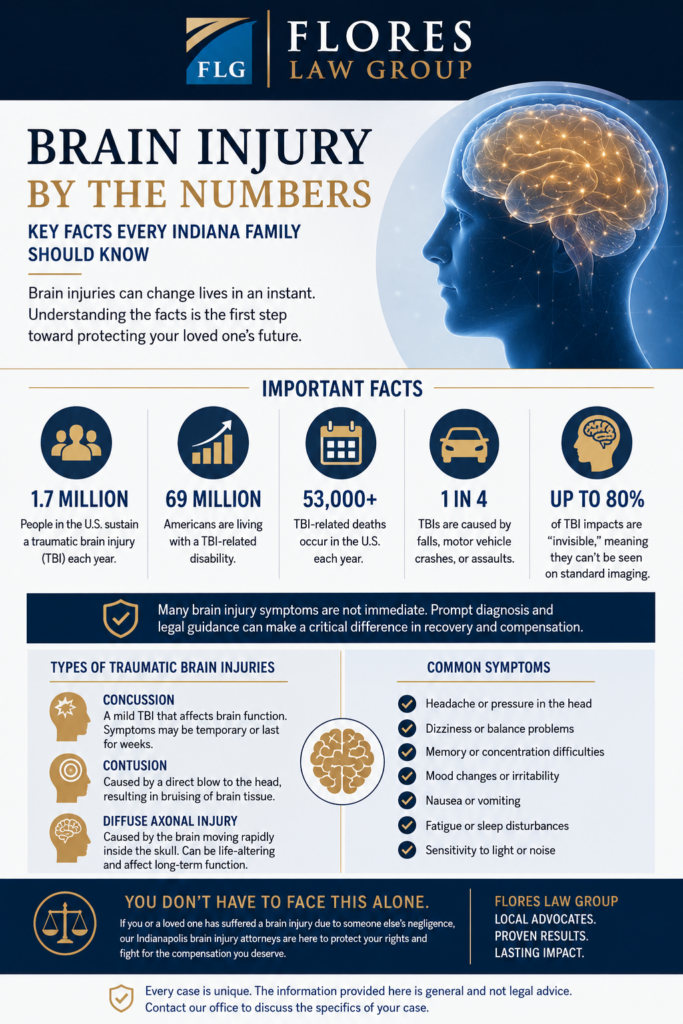
A traumatic brain injury can change a person’s life in an instant. Brain injuries often affect far more than physical health, impacting memory, emotions, decision-making, and the ability to work or live independently. For individuals and families in Indianapolis, a TBI can bring long-term medical needs, financial uncertainty, and significant emotional strain.
At Flores Law Group, our firm represents individuals who have suffered serious brain injuries due to negligence. Traumatic brain injuries frequently result from severe accidents, including motor vehicle crashes, falls, workplace incidents, and medical errors. In many cases, symptoms are not immediately obvious, and victims may not realize the full extent of their injury until days or weeks later.
Brain injuries are considered catastrophic because of their lasting effects. Some TBIs require lifelong treatment, therapy, and support. Others permanently alter a person’s ability to communicate, work, or maintain relationships. Families are often left navigating complex medical decisions while also worrying about future care and financial stability.
Our Indianapolis traumatic brain injury attorneys understand the seriousness of these cases. Flores Law Group works to help TBI victims pursue compensation that reflects both the immediate harm and the long-term impact of a brain injury. Through careful investigation and collaboration with medical experts, our firm is committed to protecting the rights of individuals and families affected by traumatic brain injuries in Indianapolis.
What Is a Traumatic Brain Injury (TBI)?
A traumatic brain injury, often referred to as a TBI, occurs when a sudden force or impact disrupts normal brain function. TBIs are typically caused by a blow to the head, violent shaking, or penetration of the skull. While some brain injuries are immediately obvious, others may be more subtle and worsen over time.
Traumatic brain injuries are commonly classified as mild, moderate, or severe, but these labels can be misleading. Even a so-called “mild” TBI, such as a concussion, can result in long-term symptoms that interfere with daily life. Brain injuries are especially dangerous because the brain controls essential cognitive, emotional, and physical functions.
Types of traumatic brain injuries include:
- Concussions, often caused by sudden impact or jolting
- Contusions, which involve bruising of brain tissue
- Diffuse axonal injuries, caused by rapid movement of the brain within the skull
- Penetrating brain injuries, involving foreign objects entering the skull
- Hypoxic brain injuries, resulting from a lack of oxygen
The effects of a traumatic brain injury can vary widely depending on the severity and location of the damage. Victims may experience memory loss, difficulty concentrating, mood changes, headaches, or sensory impairments. In severe cases, TBIs can result in permanent cognitive impairment or loss of independence.
At Flores Law Group, our Indianapolis traumatic brain injury attorneys help clients understand the nature of their brain injury and how it affects their legal claim. Our firm works to ensure that the seriousness of a TBI is fully recognized when pursuing compensation.
Common Causes of Brain Injuries in Indianapolis
Traumatic brain injuries often occur during sudden, violent events that cause the brain to move forcefully inside the skull. In Indianapolis, TBIs frequently result from accidents involving high-impact forces or unsafe conditions. Identifying the cause of a brain injury is an important step in determining liability and available compensation.
Some of the most common causes of brain injuries include:
- Car accidents, particularly high-speed or rear-end collisions
- Truck accidents, where the size and weight of commercial vehicles increase injury severity
- Motorcycle and pedestrian accidents, which offer little physical protection
- Falls, including falls on construction sites or unsafe property conditions
- Workplace accidents, involving heavy equipment or falling objects
- Medical malpractice, such as oxygen deprivation or surgical errors
- Defective products, including unsafe equipment or protective gear
Motor vehicle accidents are one of the leading causes of traumatic brain injuries in Indianapolis. Even when safety features like seat belts or helmets are used, the force of impact can still cause the brain to shift violently. Falls are another common cause, especially among workers and older adults.
Related: Brain Injuries Caused By Car Crashes in Indiana
At Flores Law Group, our Indianapolis brain injury attorneys carefully examine how a TBI occurred and what factors contributed to the injury. By identifying the cause and responsible parties, our firm works to build strong claims that reflect the full impact of a traumatic brain injury.
Symptoms and Long-Term Effects of Traumatic Brain Injuries
The symptoms of a traumatic brain injury can vary widely depending on the severity of the injury and the area of the brain affected. Some symptoms appear immediately after an accident, while others develop gradually over days or weeks. This delayed onset often makes TBIs difficult to diagnose and increases the risk of long-term complications for injured individuals in Indianapolis.
Common symptoms of a traumatic brain injury may include:
- Memory loss and difficulty concentrating
- Confusion or disorientation
- Persistent headaches or migraines
- Dizziness or balance problems
- Sensitivity to light or sound
Many brain injury victims also experience emotional and behavioral changes, such as irritability, mood swings, anxiety, or depression. These changes can strain relationships and make everyday interactions more challenging, particularly when loved ones struggle to understand the cause of the changes.
Long-term effects of a TBI can be especially disruptive and may include:
- Cognitive impairment, affecting decision-making and problem-solving
- Emotional regulation issues, including impulsivity or depression
- Physical symptoms, such as seizures, fatigue, or coordination problems
- Loss of independence, requiring assistance with daily activities
Brain injuries often affect more than just the injured individual. Family members may take on caregiving responsibilities or need to adjust their lives to accommodate ongoing medical needs. The emotional toll can be significant, as loved ones cope with changes in personality or cognitive function.
At Flores Law Group, our Indianapolis traumatic brain injury attorneys understand how deeply TBIs affect victims and families. Our firm works to document the full range of symptoms and long-term effects so compensation reflects not only immediate medical treatment but also the lasting impact of a brain injury on daily life and future stability.
Mild, Moderate, and Severe Brain Injuries
Traumatic brain injuries are commonly classified as mild, moderate, or severe, but these categories do not always reflect the true impact of a brain injury. Many Indianapolis TBI victims are told their injury is “mild,” only to discover months later that symptoms persist and interfere with work, relationships, and daily activities.
Mild traumatic brain injuries, often referred to as concussions, may not involve loss of consciousness. However, they can still cause ongoing headaches, memory problems, sleep disturbances, and emotional changes. Repeated mild TBIs can be particularly dangerous and may lead to cumulative brain damage.
Moderate traumatic brain injuries often involve longer periods of unconsciousness or more noticeable neurological symptoms. Victims may require hospitalization, rehabilitation, and ongoing medical care. Cognitive and physical limitations are common, and recovery can be unpredictable.
Severe traumatic brain injuries typically result from violent impacts or oxygen deprivation. These injuries may cause permanent brain damage, paralysis, or loss of cognitive function. Many individuals with severe TBIs require lifelong care and assistance.
Medical documentation and expert evaluation are critical in accurately assessing the severity of a brain injury. Imaging studies, neurological exams, and neuropsychological testing help establish the extent of damage and future needs.
At Flores Law Group, our Indianapolis brain injury attorneys understand that no TBI should be minimized. Our firm works to ensure that the true severity and long-term consequences of a traumatic brain injury are fully recognized when pursuing compensation.
How Traumatic Brain Injuries Affect Work and Daily Life
Traumatic brain injuries often have a profound impact on a person’s ability to work, maintain relationships, and manage daily responsibilities. Even when physical recovery appears strong, cognitive and emotional effects of a brain injury may continue to interfere with everyday life. For many Indianapolis TBI victims, returning to the life they had before the injury is not possible.
Brain injuries can affect employment in several ways. Victims may struggle with concentration, memory, decision-making, or communication, all of which are critical to most jobs. Fatigue, headaches, and sensory sensitivity can further limit productivity and endurance. In severe cases, individuals are unable to return to work at all.
Common work-related challenges following a traumatic brain injury include:
- Difficulty focusing or completing tasks
- Problems with memory and organization
- Reduced ability to handle stress or multitask
- Inability to meet physical or cognitive job demands
- Loss of career advancement or earning potential
Daily life is also significantly affected by a TBI. Routine activities such as driving, managing finances, or socializing may become difficult. Emotional changes can strain family relationships, and victims may experience frustration or isolation as they adjust to new limitations.
Families often play a critical role in supporting brain injury victims. Loved ones may need to provide supervision, assist with medical care, or help manage household responsibilities. These changes can affect the entire household’s routine and financial stability.
At Flores Law Group, our Indianapolis traumatic brain injury attorneys understand how deeply TBIs disrupt work and daily life. Our firm works to pursue compensation that reflects not only lost income but also the lasting impact a brain injury has on independence, relationships, and quality of life.
Who Can Be Held Liable for a Traumatic Brain Injury?
Traumatic brain injuries are often caused by preventable accidents and negligence. Identifying who can be held legally responsible is a critical step in pursuing compensation for a brain injury. In Indianapolis, liability may extend to multiple parties depending on how the injury occurred.
Parties that may be held liable for a traumatic brain injury include:
- Negligent drivers, in car, truck, motorcycle, or pedestrian accidents
- Employers or contractors, in workplace or construction-related incidents
- Property owners, who fail to maintain safe premises
- Medical providers, in cases involving medical malpractice or oxygen deprivation
- Manufacturers, when defective products or safety equipment contribute to injury
In many brain injury cases, multiple parties share responsibility. For example, a truck accident may involve a negligent driver, a trucking company, and a maintenance provider. A construction accident may involve contractors, subcontractors, and equipment manufacturers. Identifying all responsible parties is essential to maximizing available compensation.
Liability determination often requires a detailed investigation, including accident reconstruction, review of safety records, and expert analysis. Insurance companies may attempt to minimize responsibility by shifting blame or disputing the severity of the injury.
At Flores Law Group, our Indianapolis brain injury attorneys conduct comprehensive investigations to identify every party who contributed to a traumatic brain injury. By holding all responsible parties accountable, our firm works to pursue compensation that reflects the full impact of a TBI.
Proving a Brain Injury Claim in Indianapolis
Proving a traumatic brain injury claim requires detailed evidence and careful legal preparation. Unlike visible injuries, brain injuries are often internal and may not appear on standard imaging right away. Insurance companies frequently attempt to minimize TBIs by arguing that symptoms are subjective or unrelated to the accident, which makes strong documentation essential in Indianapolis brain injury cases.
To successfully prove a traumatic brain injury claim, several key elements must be established:
- Negligence, showing that another party failed to act with reasonable care
- Causation, demonstrating that the accident directly caused the brain injury
- Medical diagnosis, confirming the presence and severity of the TBI
- Damages, reflecting the physical, emotional, and financial impact of the injury
Medical evidence plays a central role in brain injury claims. Diagnostic imaging, neurological evaluations, and neuropsychological testing help establish how the brain was affected. Treating physicians and specialists may also provide insight into how a TBI impacts memory, behavior, and long-term functioning.
Expert testimony is often necessary in traumatic brain injury cases. Neurologists, neuropsychologists, and vocational experts may be called upon to explain how a brain injury affects daily life and employment. Life care planners may also be used to project future medical needs and long-term care costs.
At Flores Law Group, our Indianapolis traumatic brain injury attorneys work closely with qualified experts to build strong, evidence-based claims. Our firm focuses on clearly demonstrating the seriousness of a brain injury and ensuring that its long-term consequences are fully recognized when pursuing compensation.
Compensation Available for Traumatic Brain Injury Victims
Traumatic brain injuries often result in substantial and ongoing losses. Victims in Indianapolis may require compensation that accounts for immediate medical treatment as well as the long-term effects of a brain injury. Because TBIs can permanently alter a person’s ability to work and live independently, damages in these cases are often significant.
Compensation available to traumatic brain injury victims may include:
- Medical expenses, including hospitalization, rehabilitation, and future treatment
- Cognitive therapy and counseling, addressing memory and behavioral challenges
- Lost wages, when victims are unable to work during recovery
- Loss of earning capacity, if a TBI limits future employment opportunities
- Pain and suffering, accounting for physical pain and emotional distress
- Long-term care costs, such as in-home assistance or specialized facilities
In cases where a traumatic brain injury results in death, surviving family members may pursue wrongful death damages under Indiana law. These damages may include funeral and burial costs, loss of financial support, and loss of companionship and care.
Insurance companies often challenge brain injury claims aggressively, particularly when future care needs are involved. They may dispute the severity of the TBI or argue that symptoms are unrelated to the accident.
At Flores Law Group, our Indianapolis brain injury attorneys take a comprehensive approach to evaluating damages. Our firm works to understand the full impact of a traumatic brain injury and pursue compensation that supports long-term treatment, stability, and quality of life.
How Flores Law Group Helps Indianapolis TBI Victims
At Flores Law Group, our firm is committed to helping individuals and families in Indianapolis who are facing the life-altering consequences of a traumatic brain injury. TBIs require a level of legal preparation and long-term planning that goes beyond standard personal injury claims. Our firm focuses exclusively on representing injured individuals, allowing us to put our clients’ needs and future stability first.
When you work with our Indianapolis traumatic brain injury attorneys, our firm focuses on:
- Conducting detailed investigations to determine how the brain injury occurred
- Working with neurologists, neuropsychologists, and medical experts to document the severity of the TBI
- Evaluating long-term care needs, including rehabilitation and cognitive therapy
- Coordinating expert testimony, such as vocational and life care planning analysis
- Preparing every case for trial, even while pursuing fair settlement opportunities
We understand that traumatic brain injuries affect more than medical charts. They affect relationships, careers, and daily independence. Our firm prioritizes clear communication and personalized guidance so clients and families understand what to expect at every stage of the legal process. No two brain injury cases are the same, and we tailor our legal strategy to reflect each client’s specific injuries, goals, and long-term needs.
With a strong understanding of Indiana personal injury and wrongful death law, Flores Law Group works to protect the rights of those harmed by traumatic brain injuries. Our mission is to pursue compensation that supports recovery, long-term care, and the highest possible quality of life after a TBI.
Contact Flores Law Group Today for Your Indianapolis Traumatic Brain Injury Claim
A traumatic brain injury can change the course of a person’s life in an instant. If you or a loved one suffered a brain injury or TBI in Indianapolis due to negligence, taking action as soon as possible can help protect your rights and preserve critical evidence. Brain injury cases often require extensive medical documentation and expert analysis, making early legal guidance especially important.
At Flores Law Group, our firm has helped injured individuals and families throughout Indianapolis pursue compensation after serious personal injury and wrongful death cases involving traumatic brain injuries. We are committed to providing compassionate representation while holding negligent parties accountable.
To discuss your legal options, contact our Indianapolis traumatic brain injury attorneys today. Call (317) 426-4228 to speak with our team or connect with us online to schedule a consultation. Flores Law Group is ready to help you take the next step forward after a traumatic brain injury.
Reviewed for legal accuracy by Enrique S. Flores Jr. on September 8, 2026
Frequently Asked Questions
In 2026, can a brain injury settlement affect SSI eligibility, and what planning issues should families watch for?
It can. SSI is needs-based and has a countable resource limit of $2,000 for an individual and $3,000 for a couple (with important exclusions).
Because a settlement can change resources depending on how it is received and held, families often coordinate legal and benefits planning so compensation supports care while avoiding unintended benefit disruptions.
Can I have a traumatic brain injury even if I never hit my head or never lost consciousness?
Yes. A concussion (a form of mild TBI) can occur from rapid acceleration-deceleration forces, like whiplash in a crash, even without a direct head strike. And loss of consciousness is not required for a concussion diagnosis, so insurers should not treat “I did not black out” as proof there was no brain injury.
What if my CT or MRI is normal, how do you prove a brain injury case?
Many TBIs, especially concussions, may not show clear findings on standard imaging. Doctors often rely on clinical evaluation and documented symptoms, and may use neurocognitive or neuropsychological testing to measure attention, memory, processing speed, and other functions affected by TBI. That testing can help connect real-world limitations to the injury mechanism and support the need for treatment and accommodations.
My symptoms showed up days later. Does delaying care hurt my Indianapolis brain injury claim?
Delayed symptoms are common with concussion and mild TBI. The CDC notes that signs and symptoms may not appear right away and can develop hours or days after the injury. From a claim perspective, it is still important to get evaluated as soon as you notice symptoms, follow medical guidance, and document changes (headaches, sleep issues, mood, concentration) because early records help show timing, severity, and progression.
What digital evidence can strengthen a brain injury case after a wreck in Indianapolis?
Modern cases turn on data. We move fast to preserve vehicle Event Data Recorder downloads, nearby business surveillance, dashcam clips, 911 audio, and even smartphone sensor data that can corroborate a traumatic brain injury mechanism. In Indiana, many businesses overwrite footage within days, so rapid preservation letters are essential. Our attorney team handles subpoenas and chain of custody so the evidence supporting your TBI is admissible and persuasive.
How do we prove the value of lost household services after a brain injury in Indiana?
A brain injury often forces families to replace chores and caregiving the injured person used to provide. We document pre injury routines in detail, then use time studies and local Indianapolis market rates for childcare, transportation, cooking, and home maintenance to quantify those losses. Pairing this with therapist goals and functional capacity evaluations helps our attorney team show how the traumatic brain injury impacts everyday independence, not just wages.
Does it matter where in central Indiana we file a TBI lawsuit, and how can venue affect outcomes?
Venue can influence timelines, motion practice, and even jury composition. Depending on facts, we may file in Marion County or a neighboring county around Indianapolis if it is legally proper, and we weigh factors like court congestion and prior verdict trends. Strategic venue selection can shape settlement leverage in a traumatic brain injury claim. If you want a venue strategy tailored to your situation, please contact us so our attorney team can evaluate options under Indiana law.
Additional Information in Indianapolis, Indiana
- CDC Traumatic Brain Injury and Concussion: Authoritative CDC hub on TBI and concussion with guidance on symptoms, prevention, testing, recovery, data dashboards, and provider resources, including links for mild, moderate, and severe TBI information.
- Indiana Traumatic Brain Injury Model System Center at IU School of Medicine: Overview of IU School of Medicine’s TBIMS program in Indianapolis that provides comprehensive TBI care, leads multidisciplinary research, and contributes data to the national TBI database as one of only 16 federally funded centers in the United States.
- Concussion Care at IU Health: Overview of concussion as a mild traumatic brain injury, common symptoms, when to seek urgent evaluation, and IU Health’s ImPACT certified specialists for diagnosis and recovery guidance for student athletes and others.