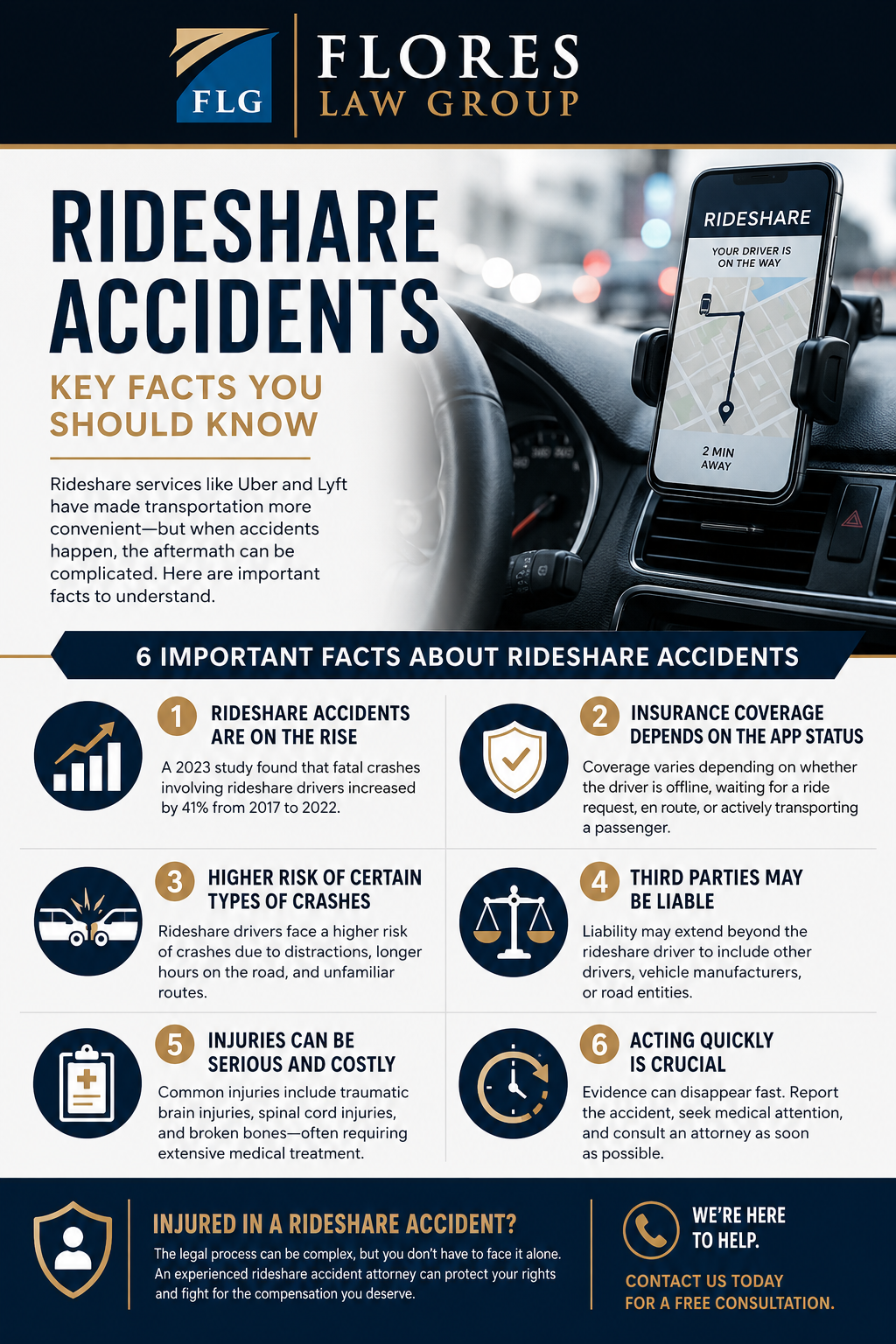
Rideshare services like Uber and Lyft have become a common part of daily life in Indianapolis. While these services offer convenience, they also introduce unique risks when accidents occur. If you were injured in an Uber accident or Lyft accident in Indianapolis, you may be facing confusing insurance questions, delayed responses from insurers, and uncertainty about who is responsible for your injuries.
At Flores Law Group, our firm understands that rideshare accident claims are not handled the same way as traditional car accident cases. Uber and Lyft accidents often involve multiple insurance policies, app-based driver status issues, and corporate insurers that aggressively defend claims. Injured victims may include rideshare passengers, occupants of other vehicles, pedestrians, or bicyclists, each facing different legal and insurance challenges.
Our Indianapolis rideshare accident attorneys help injured individuals navigate these complexities and pursue fair compensation. Whether you were hurt as a passenger in an Uber or Lyft, struck by a rideshare driver, or involved in a crash with another vehicle, our firm works to identify liability, protect your rights, and guide you through the legal process with clarity and confidence.
Why Uber and Lyft Accidents Are Different From Other Car Accidents
Uber and Lyft accidents differ significantly from traditional car accidents because they involve commercial rideshare platforms operating through app-based systems. One of the most important differences is how insurance coverage applies, which depends on the driver’s status within the Uber or Lyft app at the time of the crash. This alone can make rideshare accident claims in Indianapolis far more complex.
Rideshare drivers move between different coverage “phases,” such as waiting for a ride request, en route to pick up a passenger, or actively transporting a passenger. Each phase triggers different insurance policies, often involving a combination of the driver’s personal insurance and Uber or Lyft’s commercial coverage. Disputes frequently arise over which policy applies and when coverage is available.
Uber and Lyft accidents are also different because they often involve multiple injured parties. A single crash may result in injuries to rideshare passengers, drivers of other vehicles, pedestrians, or bicyclists. Each injured person may have a separate claim governed by different insurance rules, making early investigation critical.
Additional factors that make Uber and Lyft accidents more complex include:
- App-related distractions, such as navigation and ride management
- Driver fatigue, caused by long hours or multiple consecutive trips
- Unfamiliarity with Indianapolis streets, particularly for out-of-area drivers
- Corporate insurer involvement, which often leads to aggressive claim defenses
At Flores Law Group, our Indianapolis rideshare accident attorneys understand how these factors affect liability and compensation. Our firm works to untangle coverage issues and pursue claims against all responsible parties.
Common Causes of Rideshare Accidents in Indianapolis
Most Uber and Lyft accidents in Indianapolis are caused by preventable negligence rather than unavoidable circumstances. Rideshare drivers face unique pressures that can increase the risk of crashes, particularly when combined with busy streets, traffic congestion, and unfamiliar routes.
One of the most common causes of rideshare accidents is distracted driving. Uber and Lyft drivers regularly interact with their phones to accept rides, follow GPS directions, and communicate with passengers. Even brief distractions can lead to serious accidents in Indianapolis traffic.
Other common causes of Uber and Lyft accidents include:
- Driver fatigue, especially when drivers work long hours or multiple shifts
- Speeding or aggressive driving, often to complete trips quickly
- Frequent stopping and sudden lane changes, while picking up or dropping off passengers
- Inadequate vehicle maintenance, including worn brakes or tires
- Inexperience or unfamiliarity with local roads, increasing the likelihood of navigation errors
Rideshare accidents may also involve third-party drivers who act negligently, further complicating liability. In many cases, insurance companies attempt to shift blame or delay claims while coverage issues are sorted out.
At Flores Law Group, our Indianapolis rideshare accident attorneys conduct thorough investigations into how Uber and Lyft accidents occur. By identifying the specific cause of a crash, our firm works to establish liability clearly and pursue compensation that reflects the full impact of a rideshare accident.
Understanding Uber and Lyft Insurance Coverage in Indiana
One of the most confusing aspects of an Uber or Lyft accident is determining which insurance policy applies. Unlike traditional car accidents, rideshare accidents in Indianapolis involve multiple layers of insurance coverage that depend on the driver’s status in the app at the time of the crash. Insurance companies often dispute coverage early on, which can delay or complicate an injured person’s claim.
Uber and Lyft drivers move through different coverage phases, each with its own insurance implications. When a driver is logged into the app but has not yet accepted a ride, limited contingent coverage may apply. Once a driver accepts a ride request and is en route to pick up a passenger, or while actively transporting a passenger, Uber or Lyft’s commercial insurance coverage is typically in effect. These commercial policies generally offer higher coverage limits, but insurers may still challenge whether the driver was in the correct phase.
Insurance coverage issues become even more complex when multiple people are injured. Passengers in an Uber or Lyft accident, occupants of other vehicles, pedestrians, and bicyclists may all be covered under different policies depending on how the crash occurred. Determining which policy applies requires careful review of app data, trip records, and timing.
Insurance companies often attempt to delay claims by arguing that the rideshare driver was offline, not actively engaged in a ride, or otherwise outside the scope of coverage. These disputes can significantly affect compensation if not addressed properly.
At Flores Law Group, our Indianapolis rideshare accident attorneys understand how Uber and Lyft insurance policies operate under Indiana law. Our firm works to identify the correct coverage, preserve app-based evidence, and pursue claims against all applicable insurance policies to protect our clients’ rights.
Determining Liability in an Indianapolis Rideshare Accident
Determining liability in an Indianapolis rideshare accident is often more complex than in a standard car crash. Uber and Lyft accidents frequently involve multiple parties, overlapping insurance policies, and competing explanations of how the accident occurred. Because rideshare companies classify their drivers as independent contractors, insurance carriers often attempt to avoid responsibility unless liability is clearly established.
In many cases, a rideshare driver’s negligence is the primary cause of the accident. Uber and Lyft drivers may be distracted by their app, unfamiliar with Indianapolis roads, or rushing to complete trips. However, liability does not always stop with the rideshare driver. Depending on the circumstances, several parties may share responsibility for an Uber or Lyft accident.
Potentially liable parties in an Indianapolis rideshare accident may include:
- The Uber or Lyft driver, if negligent driving caused the crash
- A third-party driver, when another motorist’s actions contributed to the accident
- An employer or commercial entity, if a work vehicle was involved
- Uber’s or Lyft’s insurance providers, depending on the driver’s app status
- Multiple insurers, when fault is disputed or shared
Indiana’s comparative fault rules often play a significant role in rideshare accident claims. Insurance companies may attempt to assign partial blame to injured passengers, other drivers, pedestrians, or bicyclists to reduce the compensation owed. These arguments are common, particularly in complex Uber and Lyft accident cases involving multiple vehicles or conflicting witness accounts.
Related: Determining Liability in an Uber or Lyft Accident in Indianapolis
At Flores Law Group, our Indianapolis rideshare accident attorneys conduct detailed investigations to determine liability accurately. We review police reports, rideshare app data, witness statements, and physical evidence to identify every responsible party. By building strong, evidence-based claims, our firm works to protect injured victims and pursue full and fair compensation after an Uber or Lyft accident.
Injuries Commonly Caused by Uber and Lyft Accidents
Uber and Lyft accidents often result in serious injuries, particularly when crashes occur at higher speeds or involve multiple vehicles. Whether you were injured as a passenger in a rideshare vehicle, struck by an Uber or Lyft driver, or involved in a collision with another car, the injuries suffered in these accidents can be severe and life-altering. In Indianapolis, rideshare accidents frequently occur on busy roads, downtown streets, and highways where the risk of serious harm is elevated.
Some of the most common injuries seen in Indianapolis Uber and Lyft accident cases include:
- Traumatic brain injuries, including concussions and long-term cognitive impairment
- Spinal cord, neck, and back injuries, which may lead to chronic pain or limited mobility
- Broken bones, particularly to the arms, legs, ribs, and collarbone
- Soft tissue injuries, such as whiplash, muscle strains, and ligament damage
- Internal injuries, including organ damage or internal bleeding
Many rideshare accident victims require emergency medical treatment followed by weeks or months of rehabilitation. Some injuries may not be immediately apparent at the scene of an Uber or Lyft accident, which makes prompt medical evaluation especially important. Delayed symptoms are common in cases involving head injuries or internal trauma.
In serious cases, Uber and Lyft accident injuries can result in permanent disability, long-term medical needs, or an inability to return to work. These consequences often place significant financial and emotional strain on injured individuals and their families.
At Flores Law Group, our Indianapolis rideshare accident attorneys work closely with medical providers to understand the full extent of our clients’ injuries. This allows our firm to pursue compensation that reflects not only immediate medical costs but also future treatment, lost income, and the lasting impact of a rideshare accident.
Evidence That Can Strengthen an Uber or Lyft Accident Claim
Strong evidence is critical in any Uber or Lyft accident claim, particularly because rideshare companies and their insurers often dispute liability and coverage. Unlike standard car accidents, rideshare cases frequently involve app-based data and multiple insurance policies, making early evidence preservation especially important in Indianapolis rideshare accident cases.
Key evidence that can strengthen an Uber or Lyft accident claim includes:
- Police reports, documenting the crash, statements, and any citations issued
- Rideshare app data, including trip status, timestamps, and driver activity
- Witness statements, from passengers, bystanders, or other drivers
- Photographs and video footage, including dash cameras, traffic cameras, or nearby surveillance
- Medical records, detailing injuries, treatment, and long-term prognosis
Rideshare app data is particularly valuable because it can establish whether the driver was logged into Uber or Lyft and actively engaged in a ride at the time of the accident. Without prompt action, this information may be difficult to obtain or disputed by insurers.
Insurance companies often begin building their defense immediately after an Uber or Lyft accident. Evidence can be lost quickly if vehicles are repaired, video footage is overwritten, or witnesses become unavailable.
At Flores Law Group, our Indianapolis rideshare accident attorneys take immediate steps to preserve critical evidence. By securing app records, gathering documentation, and working with qualified experts when needed, our firm builds strong claims designed to establish liability and pursue fair compensation for rideshare accident victims.
Compensation Available to Rideshare Accident Victims in Indianapolis
Rideshare accidents often result in significant physical, emotional, and financial losses. Whether you were injured as a passenger in an Uber or Lyft accident, struck by a rideshare driver, or hurt in a collision involving another vehicle, Indiana law allows injured victims to pursue compensation for the harm they have suffered. Because rideshare accidents frequently involve serious injuries, compensation claims may be substantial.
Compensation available in an Indianapolis rideshare accident case may include:
- Medical expenses, including emergency treatment, hospitalization, surgery, rehabilitation, and future care
- Lost wages, when injuries prevent a return to work during recovery
- Reduced earning capacity, if injuries limit long-term employment options
- Pain and suffering, accounting for physical pain, emotional distress, and loss of enjoyment of life
- Permanent disability or disfigurement, including long-term mobility issues or scarring
In more severe cases, compensation may also address ongoing medical needs, assistive devices, or home modifications. When an Uber or Lyft accident results in a fatality, surviving family members may be able to pursue wrongful death damages under Indiana law.
Despite the availability of compensation, rideshare insurance companies often attempt to minimize payouts by disputing liability, downplaying injuries, or delaying claims through coverage arguments. These tactics are common in Uber and Lyft accident cases and can significantly affect the outcome if not challenged properly.
At Flores Law Group, our Indianapolis rideshare accident attorneys take a comprehensive approach to evaluating damages. We work to understand the full impact of a rideshare accident and pursue compensation that accurately reflects both current losses and future needs.
What to Do After an Uber or Lyft Accident in Indianapolis
If you were injured in an Uber accident or Lyft accident in Indianapolis, the steps you take immediately afterward can have a significant impact on your health and your ability to pursue compensation. Rideshare accidents involve unique insurance and reporting requirements, making it especially important to act carefully and deliberately.
After an Uber or Lyft accident, injured individuals should take the following steps whenever possible:
- Seek medical attention right away, even if injuries seem minor, as some symptoms may be delayed
- Call law enforcement so an official accident report is created
- Document the scene, including vehicle damage, injuries, road conditions, and traffic signals
- Collect contact information from the rideshare driver, other drivers, and any witnesses
- Take screenshots of the rideshare app, showing trip details, timestamps, and driver information
It is also important to report the accident through the Uber or Lyft app. This creates a record of the incident, but injured individuals should be cautious about providing detailed statements before understanding their legal rights. Insurance companies representing Uber, Lyft, or other drivers may reach out quickly and attempt to obtain recorded statements or early settlements.
Avoid discussing fault or minimizing injuries when speaking with insurers. Statements made early on can later be used to dispute liability or reduce compensation. Keeping copies of medical records, bills, and accident-related expenses is also critical.
At Flores Law Group, our Indianapolis rideshare accident attorneys help injured victims navigate these early steps and avoid common mistakes. By taking the right actions after an Uber or Lyft accident, injured individuals can protect their health, preserve key evidence, and strengthen their ability to pursue fair compensation.
How Flores Law Group Helps Indianapolis Rideshare Accident Victims
At Flores Law Group, our firm is dedicated to helping injured individuals navigate Uber and Lyft accident claims in Indianapolis. We represent only injured clients, which allows us to focus entirely on protecting our clients’ rights and pursuing fair outcomes without divided interests.
When you work with our Indianapolis rideshare accident attorneys, our firm focuses on:
- Conducting thorough investigations to identify negligence and applicable insurance coverage
- Preserving critical evidence, including rideshare app data and crash documentation
- Handling all communication with Uber, Lyft, and insurance companies
- Working with medical professionals and experts to fully document injuries
- Preparing every case for trial, even while pursuing settlement negotiations
We understand that rideshare accident victims often feel overwhelmed by medical bills, insurance calls, and uncertainty about what to do next. Our firm prioritizes clear communication, personalized attention, and honest guidance throughout the legal process.
With a strong understanding of Indiana personal injury law and experience handling complex insurance disputes, Flores Law Group is prepared to challenge insurer tactics and advocate for injured rideshare accident victims. Our goal is to help clients move forward with stability and confidence after an Uber or Lyft accident.
Contact Flores Law Group Today for Your Indianapolis Rideshare Accident Claim
Rideshare accidents can leave victims facing serious injuries and confusing insurance issues. If you were injured in an Uber accident or Lyft accident in Indianapolis, taking action as soon as possible can help protect your rights and preserve important evidence.
At Flores Law Group, our firm has helped injured individuals throughout Indianapolis pursue compensation after complex accidents involving rideshare companies. We are committed to holding negligent drivers and insurers accountable while providing compassionate support during difficult times.
To discuss your legal options, contact our Indianapolis rideshare accident attorneys today. Call (317) 426-4228 to speak with our team or connect with us online to schedule a consultation. Our firm is ready to help you take the next step forward after a rideshare accident.
Reviewed for legal accuracy by Enrique S. Flores Jr. on September 8, 2026
Frequently Asked Questions
In 2026, what if my Indianapolis rideshare accident involves a city vehicle or a roadway condition maintained by a government entity?
If a potential defendant is a political subdivision (for example, a city or county), Indiana’s Tort Claims Act can require a notice of claim within 180 days, or the claim may be barred.
That’s why rideshare crashes involving government vehicles, certain transit situations, or alleged roadway maintenance issues are worth flagging early, because the notice deadline can come up fast.
What insurance limits apply in Indiana if the Uber or Lyft driver was logged in but had not accepted a ride yet?
Indiana’s Transportation Network Company statute sets minimum coverage amounts that depend on the driver’s app status. When a rideshare driver is logged on but not engaged in a prearranged ride, the law requires primary liability coverage of at least $50,000 per person, $100,000 per incident for bodily injury/death, and $50,000 per incident for property damage (for incidents after June 30, 2024).
If the at fault driver is uninsured or underinsured, can Uber or Lyft coverage still help an injured passenger?
It can, depending on the situation and the applicable policy. Uber’s insurance information indicates it addresses whether uninsured/underinsured motorist (UM/UIM) coverage is maintained on behalf of riders and drivers. Lyft’s insurance guidance similarly explains how Lyft’s policies may cover drivers and or passengers, and it provides access to certificates of insurance. In practice, UM/UIM questions can turn on factors like trip status, who caused the crash, and which policy applies first.
Does not wearing a seat belt affect an Indiana rideshare injury claim?
Potentially. Indiana’s seat belt statute says failure to use a seat belt does not constitute fault under Indiana’s comparative fault law, but the statute also addresses when noncompliance evidence may be admitted for mitigation of damages, with different rules depending on whether the cause of action accrued before July 1, 2024 or after June 30, 2024. This can matter in rideshare crashes because insurers may look for ways to reduce damages even when liability is clear.
How do we approach multi vehicle collisions that involve a rideshare in Indianapolis?
Chain reaction crashes can involve several policies and competing versions of events. We map out every impact using photos, debris fields, and EDR data, then coordinate statements so your account is not diluted by conflicting insurer narratives. Because Indiana uses comparative fault, we quantify each party’s share while preserving access to Uber or Lyft coverage if the driver was online or on trip in Indianapolis.
Can visitors or business travelers recover for an Indianapolis rideshare accident if they live outside Indiana?
Yes. We routinely help out of state passengers who were hurt in an Uber or Lyft within Indianapolis city limits and throughout central Indiana. We handle jurisdiction and venue questions, coordinate care with your home providers, and manage time zone and travel constraints so your claim moves smoothly with local attorney support even if you have already returned home.
How quickly do we move to preserve crucial video and trip evidence after a rideshare crash in Indianapolis?
Time matters because nearby businesses often overwrite surveillance and drivers may replace phones that hold key data. We issue preservation letters to Uber or Lyft, request intersection and storefront footage around the Indianapolis scene, and lock down witness info before memories fade under Indiana’s evidence rules. If you were injured in a rideshare accident here, please reach out to Flores Law Group so we can start protecting the proof and your recovery immediately.
Additional Information in Indianapolis, Indiana
- Indiana State Police Crash Reports: Find out how to obtain official Indiana vehicle crash reports through the state’s central repository. The page explains that reports are available online for a nominal fee via the BuyCrash portal and notes options for government agency requests. It is a direct resource for locating and purchasing Indianapolis and statewide accident reports quickly.
- Lyft Help – Insurance coverage while driving with Lyft: Overview of Lyft’s insurance that applies based on driver app status, including when the app is on, a ride is accepted, and a trip is in progress. It clarifies what Lyft’s policy may cover for drivers and passengers, and links to certificates of insurance. Useful for understanding which policy may apply after a Lyft crash.
- Child Passenger Safety Perception and Practices in Ride-Sharing Vehicles: Brief research summary on how children are restrained in ride-share vehicles like Uber and Lyft. It highlights observational findings from 2022 and points to the full report for detailed data and recommendations. Helpful for safety context in rideshare cases involving child passengers.