After a car accident in Indianapolis, victims often face overwhelming challenges. From mounting medical bills to aggressive insurance companies pushing for quick settlements, the aftermath of a car crash can feel impossible to navigate alone. That’s why having an experienced car accident attorney in Indianapolis is crucial for protecting your rights and securing the compensation you deserve.
At Flores Law Group, our Indianapolis car accident attorneys have established a proven track record of helping accident victims through every step of the legal process. We understand the physical, emotional, and financial toll a motor vehicle accident takes on victims and their families.
Our experienced Indiana car accident lawyers work tirelessly to hold negligent drivers accountable while allowing you to focus on what matters most – your recovery.
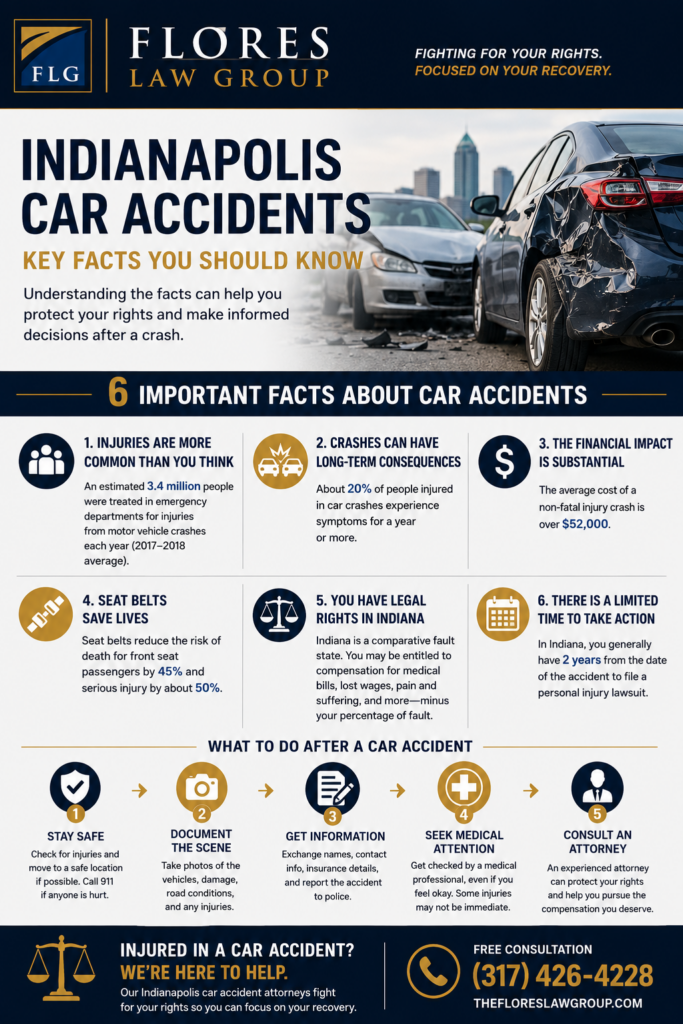
Steps to Take After an Indianapolis Car Accident
The actions you take in the immediate aftermath of a car accident can significantly impact your ability to secure fair compensation through a personal injury claim. While each car accident case is unique, following these essential steps helps protect your legal rights and strengthens your position when seeking financial compensation for damages.
Actions to Take at the Accident Scene
Your first priority after any car accident should be your safety. If possible, move to a secure location and call 911 immediately. The responding officers will create a police accident report, a crucial document for your car accident claim.
While waiting for emergency responders, document everything you can about the accident scene:
Take photographs of all vehicle damage
Capture images of any visible injuries
Document road conditions and weather
Note the position of the vehicles involved
Collect contact information from witnesses
Get insurance details from other drivers
However, it’s critical to avoid discussing fault or apologizing, as these statements could be used against you by insurance adjusters later.
If you cannot do these things because you are incapacitated, a personal injury attorney can collect and review evidence from the scene.
Seeking Medical Treatment
Even if you don’t think you are injured, seeking medical treatment promptly after a car crash is crucial. Many injuries sustained, including soft tissue injuries and traumatic brain injury, may not show immediate symptoms. Furthermore, medical records establishing a clear link between the accident and your injuries are essential for your car accident case.
During treatment:
Follow all doctor recommendations
Keep detailed records of medical expenses and medical bills
Document missed time from work
Track all medications and treatments
Maintain a pain journal
Common Car Accident Injuries
Any accident that involves a serious injury should be taken seriously by the victim and the courts. Some injuries are more common than others, but all injuries deserve fair compensation. Here are some of the most common injuries sustained in Indianapolis car accident cases.
Traumatic Brain Injuries (TBI): includes concussions, contusions, a diffuse axonal injury, penetrating brain injuries. post-concussion syndrome, and coup-contrecoup injuries
Bone Fractures: includes skull fractures, facial fractures, vertebrae fractures, rib fractures, arm and leg fractures, pelvic fractures, compound fractures, stress fractures, and compression fractures.
Internal Injuries: includes internal bleeding, organ damage, punctured lungs, ruptured spleen, kidney damage, liver lacerations, bowel injuries
Face and Eye Injuries: includes orbital fractures, retinal detachment, vision loss, dental injuries, jaw fractures, facial lacerations, and eye socket damage
Neck and Back Injuries: includes cervical strain, thoracic spine injuries, lumbar sprains, disc herniation, spinal stenosis, facet joint injuries, and compression fractures
Psychological Injuries: includes post-traumatic stress disorder (PTSD), anxiety, depression, sleep disorders, emotional trauma, and panic attacks.
Extremity Injuries: includes crush injuries, amputations, deep lacerations, degloving injuries, compartment syndrome, nerve damage, vascular injuries
Long-Term Complications: includes chronic pain, reduced mobility, neurological disorders, arthritis, complex regional pain syndrome, post-concussion syndrome, and chronic fatigue
Each of these injury types can vary in severity and may require different levels of medical treatment, from emergency care to long-term rehabilitation. They can lead to lost wages from missed work, as well as a permanent change to your lifestyle.
Many injuries may not be immediately apparent after a car accident, which is why seeking prompt medical attention is crucial for documentation and proper treatment.
Dealing with Insurance Companies
After an Indianapolis car crash, you’ll need to notify your own insurance company about the incident. However, exercise caution when communicating with the other driver’s insurance company. An insurance adjuster will often try to minimize payouts by:
Requesting recorded statements
Pushing for quick settlements
Disputing injury severity
Questioning medical treatment
Attempting to shift the fault
This is why having an experienced car accident attorney in Indianapolis handle insurance company communications with the insurance company is crucial. Your lawyer can protect your interests and prevent insurance companies from taking advantage of you during a vulnerable time.
Property Damage vs. Personal Injury Claims
Indiana law requires drivers to carry minimum coverage of:
$25,000 per person for personal injury
$50,000 per accident for personal injury
$25,000 for property damage
Currently, Indiana car insurance policies must also include underinsured motorist coverage, unless you turn down this coverage in writing. Property damage and personal injury claims are handled separately by insurance companies. Even though most of your settlement will come from personal injury coverage, property damage claims are paid from the required $25,000 property damage coverage.
Vehicle Value and Repairs
When your vehicle is damaged in an accident:
Insurance adjusters from the insurance company determine your vehicle’s pre- and post-accident value
You’re entitled to recover the difference in value
If repairs exceed 75% of the vehicle’s Kelly Blue Book Value, it may be declared “totaled”
You can keep a totaled vehicle, but the payout will be less
Future resale value may be affected
The title must note salvage status
Understanding Common Types of Indianapolis Car Accidents
Our Indianapolis car accident lawyers handle all varieties of motor vehicle accidents. Each type presents unique challenges in proving liability and securing compensation. Here are some of the most common cases we handle:
Rear-End Collisions: These frequent accidents often result from drivers being distracted or tailgating. While sometimes dismissed as minor “fender benders,” rear-end crashes can cause serious injuries like whiplash and spinal damage.
T-Bone/Side-Impact Crashes: Common at intersections, these accidents often result in severe injuries due to the limited protection on vehicles’ sides. They frequently occur when an at-fault driver runs a red light or fails to yield.
Head-On Collisions: Among the most dangerous types of car accidents, head-on crashes often result from drunk driving or distracted driving. This kind of motor vehicle accident frequently leads to catastrophic injuries or wrongful death claims.
Multi-Vehicle Pileups: These complex cases often involve multiple insurance companies and disputed liability. Having an experienced auto accident attorney is crucial for navigating these complicated claims.
Construction Zone Accidents: Accidents involving multiple potentially liable parties can be legally complex, especially when government entities share responsibility. These cases require thorough investigations into safety protocols to determine whether negligence played a role. Additionally, they often involve navigating intricate regulations that can impact liability and compensation.
Rideshare Accidents (Uber/Lyft): Rideshare accident coverage depends on the driver’s status at the time of the crash, such as whether they were waiting for a ride, en route, or transporting a passenger. Multiple insurance policies may apply, including personal auto insurance and the rideshare company’s coverage, with different levels of protection based on the app’s status. Additionally, these accidents often have special reporting requirements that drivers must follow to ensure proper claims processing.
Interstate/Highway Accidents: Highway accidents often occur at higher speeds, leading to severe injuries and significant property damage. These crashes may cross jurisdictional boundaries and involve multiple law enforcement agencies, especially when commercial vehicles are involved. Due to their complexity, they require extensive investigations to determine liability and ensure compliance with state and federal regulations.
Common Causes of Indianapolis Car Accidents
Understanding what causes car accidents helps prevent them and establishes liability in car accident claims. The National Highway Traffic Safety Administration identifies several leading causes. Your Indiana car accident was likely caused by one of the following risky behaviors.
Distracted Driving: With the rise of smartphone use, distracted driving has become increasingly problematic. Indiana law prohibits texting while driving, but many car accidents still result from drivers taking their attention off the road.
Impaired Driving: Drunk driving remains a serious issue in Indianapolis. These cases often involve both criminal charges and civil personal injury claims against the negligent drive.
Aggressive Driving: Road rage and aggressive driving behaviors contribute to many serious car accidents. These cases may warrant additional punitive damages due to the driver’s reckless conduct.
Poor Weather Conditions: While weather isn’t directly negligent behavior, drivers have a duty to adjust their driving for conditions. Failure to do so can constitute negligence in a car accident case.
How To Prove Negligence After a Car Crash
Successfully securing compensation requires your car accident attorney to prove the other driver’s negligence. This process involves gathering and presenting compelling evidence of liability. The good news is that car accident victims don’t have to do this on their own. After all, accident victims should not be expected to know the ins and outs of personal injury law.
Auto accident lawyers work with their clients to investigate the accident and determine who was responsible.
Elements of Negligence
To win your car accident claim, an experienced injury lawyer will need to prove these four facts to be true:
Duty of Care: All drivers owe others a duty to operate their vehicles safely
Breach of Duty: The at-fault driver violated this duty
Causation: This breach directly caused your accident
Damages: You suffered actual losses as a result
Evidence Collection
Your Indianapolis car accident lawyer will gather various forms of evidence:
Police accident report
Witness statements
Surveillance footage
Medical documents and records
Expert testimony
Accident reconstruction reports
Evidence collection can get complicated, especially when the accident victims involved are seriously injured in a complex accident with multiple causes and responsible parties. Your Indianapolis car accident attorney will collect evidence on your behalf, no matter how complicated the case is.
Types of Indianapolis Car Accident Compensation Available to You
Car accident victims may be entitled to various types of compensation. Understanding these different categories helps ensure you seek full and fair compensation for all your losses when you contact a car accident attorney in Indianapolis.
Economic Damages
These tangible losses include:
Current and future medical expenses: All costs related to treating your injuries, including emergency room visits, hospital stays, surgeries, doctor appointments, medications, physical therapy, and any anticipated future medical care needed for your injuries.
Lost wages and reduced earning capacity: Compensation for any missed work due to your injuries, including salary, commissions, bonuses, and benefits. This also covers any reduction in your ability to earn money in the future due to permanent limitations from your injuries.
Property damage: The cost to repair or replace your vehicle, personal belongings damaged in the crash (such as phones, laptops, or other valuable items), and any other property damaged in the accident.
Rehabilitation costs: Expenses for physical therapy, occupational therapy, speech therapy, cognitive rehabilitation, and any other specialized treatment needed to help you recover from your injuries.
Transportation expenses: Costs of medical transportation, including ambulance fees and travel expenses to and from medical appointments. This may also include the cost of alternative transportation while your vehicle is being repaired.
Home modification needs: Expenses for adapting your home to accommodate any disability or limitation resulting from your injuries, such as wheelchair ramps, bathroom modifications, or special equipment installation.
Non-Economic Damages
These more subjective losses include:
Pain and suffering: Compensation for the physical pain and discomfort you’ve experienced due to your injuries, both during initial treatment and any ongoing pain that affects your daily life.
Emotional distress: The psychological impact of the accident and injuries, including anxiety, depression, fear, sleep disturbances, and post-traumatic stress disorder (PTSD).
Loss of enjoyment of life: Compensation for your inability to participate in hobbies, sports, or other activities you enjoyed before the accident, as well as the overall reduction in your quality of life.
Permanent disability: The long-term impact of any permanent limitations or disabilities resulting from your injuries, including how they affect your daily activities, independence, and future opportunities.
Disfigurement: Compensation for permanent scarring, burn marks, amputations, or other visible changes to your appearance that result from the accident and may affect your self-image and social interactions.
Loss of consortium: Damages awarded for the impact your injuries have had on your relationship with your spouse or partner, including loss of companionship, affection, and intimate relations. This can also include the strain on family relationships due to your injuries.
Understanding these damages is crucial because insurance companies often focus solely on economic damages while minimizing or ignoring non-economic damages. An experienced team of auto accident attorneys will help ensure all types of damages are properly documented and included in your claim to maximize your compensation.
Indiana Fault Laws and Accidents
A key component of any injury claim, including injuries from an Indiana car accident, is to prove who was at fault. Each state sets its own rules that determine what happens when multiple parties contribute to the accident. After a car accident in Indiana, the state determines who can and who cannot seek compensation.
Indiana’s modified comparative fault system significantly impacts car accident claims. This system allows victims to seek a fair settlement, but only if they’re less than 51% responsible for the accident.
How Comparative Fault Works
The math of comparative fault is straightforward. If you were partially responsible for the accident, tour compensation will be reduced by your percentage of fault. For example:
If you are awarded $100,000 but found 20% at fault, you receive $80,000
If you are awarded $100,000 but found to be 10% at fault, you receive $90,000
If you’re found 51% or more at fault, you cannot recover compensation
This makes having an experienced car accident lawyer crucial for getting a fair settlement. Your attorney will work on:
Minimizing your assigned fault percentage
Maximizing your potential compensation
Countering insurance company tactics
Presenting compelling evidence of the other party’s liability
Extended Statute of Limitations Information
Indiana is like most other states, and the injured party has only two years to file a personal injury lawsuit. However, there are some important exceptions to the typical statute of limitations. In the following personal injury cases, injured parties may be able to file long after the accident date. Personal injury attorneys understand these rules and can answer your questions if you want to determine your eligibility to file a claim more than two years after your accident.
Minors
The statute doesn’t begin until the minor turns 18
They have until their 20th birthday to file a claim
Government Claims
Claims against cities/counties: Must file notice within 180 days
Claims against state entities: Must file notice within 270 days
Strict procedural requirements apply
Discovery Rule
May apply when injuries aren’t immediately apparent
The clock starts when an injury is discovered or should have been discovered
Limited to specific circumstances
How Our Indianapolis Car Accident Attorneys Can Help
At Flores Law Group, our experienced car accident lawyers understand that the aftermath of a serious car accident can overwhelm victims and their families. Our comprehensive approach ensures you receive the support, guidance, and aggressive representation needed to secure fair compensation for your injuries.
Thorough Investigation and Evidence Gathering
A car accident attorney in Indianapolis will launch a complete investigation immediately after you retain our services. We know that evidence can disappear quickly after a car accident, so we act fast to:
Thoroughly investigate your accident by visiting the scene, photographing evidence, and documenting road conditions, skid marks, debris patterns, and other critical physical evidence that could support your claim
Collect and preserve critical evidence including surveillance footage from nearby businesses, dashcam videos, cell phone records of the other driver, vehicle maintenance records, and any other documentation that could prove negligence
Interview witnesses promptly while memories are fresh, obtaining detailed statements and contact information for future testimony if needed
Work with accident reconstruction experts who can create detailed analyses and compelling visual presentations that clearly demonstrate how the accident occurred and who was at fault
Review police reports, medical records, and bills with meticulous attention to detail, identifying any inconsistencies or missing information that could affect your claim
Obtain employment records and documentation of lost wages to establish the full financial impact of your injuries
Strategic Insurance Company Negotiations
The attorneys at our law firm have decades of combined experience dealing with insurance companies and know their tactics. We will:
Handle all communications with the insurance company and their adjustors
Evaluate settlement offers
Negotiate aggressively for maximum compensation
Protect you from unfair tactics like:
Pressure to accept quick, lowball settlements
Requests for recorded statements that could be used against you
Attempts to shift blame or minimize your injuries
Delays or denial of valid claims
Misrepresentation of coverage or policy limits
Comprehensive Legal Representation
Our experienced car accident attorneys provide complete legal support, including expert guidance through every step of the legal process. From the initial filing through the resolution of your case, we ensure that you understand your rights and options at every stage.
Flores Law Group prepares every case as if it is going to trial, even though we know that most cases will end with a negotiated settlement. Our comprehensive legal support means that we can provide skilled trial representation, including:
Jury selection strategy
Opening and closing arguments
Examination of witnesses
Presentation of evidence
Expert testimony coordination
Legal motion practice
We also protect your rights by meeting all legal deadlines, filing your court documents in a timely manner, responding to defense motions, maintaining attorney-client privilege, and ensuring compliance with all Indiana court rules.
Car Accident Attorney Indianapolis: Contact Flores Law Group Today
At Flores Law Group, we don’t want you to face the aftermath of a serious car accident alone. Contact our experienced Indianapolis car accident lawyers today for a free consultation. Call us at 317-900-2556 to set up a time to talk.
We work on contingency, meaning you pay nothing unless we win your case. With decades of combined experience handling car accident claims in Indianapolis, we know what it takes to get results. Let us fight for the full and fair compensation you deserve while you focus on recovery.
In 2026, can my car’s “black box” (event data recorder) or telematics data be used as evidence after a car accident in Indianapolis?
Often, yes. Federal regulations define an event data recorder (EDR) as a device or function that records certain vehicle data in the period just before and during a crash event, intended for retrieval after the crash, and the federal EDR rule framework is in 49 CFR Part 563. Practically, that means you should preserve the vehicle and avoid repairs or data-wiping steps until counsel can evaluate whether EDR or connected-vehicle data should be downloaded
How do I get the official police crash report for my Indianapolis car accident?
The Indiana State Police maintains the central repository of crash reports and makes many reports available online through the BuyCrash system for a fee. Having the report helps confirm basic facts like date, location, parties, and the investigating agency.
What if the driver who hit me was uninsured or fled the scene? Can my own insurance still help?
Possibly. Indiana law requires insurers to make uninsured and underinsured motorist coverage available in auto policies (unless properly rejected). In many cases, UM coverage can be a key option when the at fault driver has no coverage, not enough coverage, or cannot be identified.
What if the other driver tries to leave, or says we should “handle it privately” without calling police?
Indiana law imposes duties on drivers involved in a crash, including stopping at or near the scene and completing required steps. If someone tries to leave, prioritize safety, call 911, and document identifiers like the license plate, vehicle description, and any witnesses.
How long do I have to file a claim?
Indiana’s statute of limitations gives you two years from the accident date to file a personal injury lawsuit. However, it’s crucial to start working with an auto accident attorney much sooner to: • Preserve evidence • Interview witnesses while memories are fresh • Meet insurance deadlines • Build a stronger case
What if an uninsured driver hits me?
If you’re hit by an uninsured or underinsured motorist, you may have several options: • File a claim under your uninsured motorist coverage • Pursue compensation from other liable parties • Explore other insurance policies that might apply Your Indianapolis car accident attorney can help identify all potential sources of compensation.
How much is my car accident case worth?
Every car accident claim is unique. The value of a personal injury case depends on factors like: • Severity of injuries • Amount of medical bills • Lost income • Long-term impairment • Pain and suffering • Available insurance coverage • Strength of liability evidence You can see that compensation may cover both financial and non-economic losses related to your motor vehicle accident. Your pain and suffering are just as much of a factor as your medical bills for serious injuries.
Should I accept the insurance company’s first offer?
Insurance companies typically make low initial offers after an auto accident, hoping you’ll settle quickly before understanding your full damages. Let an experienced car accident lawyer negotiate on your behalf to ensure you receive fair compensation.
How much does a car accident injury claim usually cost?
At Flores Law Group, we operate on a contingency fee basis, which means that there are no upfront costs required. Most law firms charge between 33-40% for coverage. That percentage may increase if the case goes to trial. However, it is important to know that when your lawyer works on a contingency basis, you only pay fees if the law firm settles your case. Some of the costs that may fall to the client after winning the case include: • Court filing fees • Expert witness fees • Medical record costs • Investigation expenses These are typically reimbursed from the settlement or court award amount.
What rights do undocumented individuals have after an accident?
Undocumented individuals have the same right to seek compensation after a car accident as anyone else. Immigration status does not affect your ability to file a personal injury claim or lawsuit against a negligent driver. A car accident attorney in Indianapolis will: • Protect your rights and privacy • Handle your case with complete confidentiality • Fight for full and fair compensation • Address any immigration-related concerns
What damages can an attorney pursue after a car accident in Indianapolis, Indiana?
In a typical Indiana car accident case, recoverable damages can include medical expenses, future treatment, lost wages, reduced earning capacity, pain and suffering, and property losses. We also evaluate less obvious harms like diminished vehicle value and the impact injuries have on your daily life in Indianapolis. As your attorney team, we quantify these losses with medical opinions and documentation to support strong negotiations or trial.
How long do I have to file an Indianapolis car accident lawsuit in Indiana?
For most personal injury claims arising from a car accident, Indiana’s statute of limitations is generally two years from the date of the crash. Starting early helps us secure time-sensitive evidence such as vehicle data, intersection footage, and witness memories in Indianapolis. We track every deadline and handle all filings so your attorney can keep your case moving without last-minute risk.
Will the insurance company’s first offer be fair after a car accident in Indianapolis?
Rarely. Early offers tend to undervalue future care, missed work, and long-term pain or limitations under Indiana law. We review your medical trajectory, consult with experts when needed, and leverage documented losses from your Indianapolis providers. If you’re getting calls from adjusters, skip the recorded statement and contact us so we can speak for you and pursue the full value of your claim.
Additional Information in Indianapolis, Indiana
Indiana Code 9-26-1-1.1 - Driver Responsibilities After an Accident: Requires drivers to stop, share identification and registration, aid injured persons, and notify law enforcement or 911 after a crash. Noncompliance can result in criminal penalties that escalate when injuries, death, or intoxication are involved.
Seat Belt Safety Overview: A National Highway Traffic Safety Administration resource explaining why seat belts save lives, key statistics, how to wear them properly, state laws and enforcement campaigns, guidance for children, pregnant drivers, and older occupants, plus downloads and research for safety advocates.
Indiana State Police Crash Reports: Official resource explaining how to access Indiana crash reports, with links to purchase reports, answers to common questions, and guidance for drivers, insurers, and attorneys.
Practice Areas
Contact us
Call a Lawyer Today
Accidents can happen at any time, whether on the way to the store or while at work. These accidents can often lead to serious injuries. Injured individuals are often at a loss when dealing with insurance companies, especially when their lives have been changed permanently. Our office fights for the rights of those affected by workplace accidents or accidents caused by the negligence of others. We will help you navigate your claim and help you understand your rights from the first phone call. Contact us today for a Free Consultation.
By submitting this form and signing up for texts, you consent to receive informational text messages regarding case details, document requests, intake follow-ups, status updates, and appointment reminders from Flores Law Group, LLC at the number provided, including messages sent by an autodialer. Consent is not a condition of hiring our firm. Message and data rates may apply. Message frequency varies. Unsubscribe at any time by replying STOP. Reply HELP for help. Mobile information will not be shared with third parties/affiliates for marketing/promotional purposes. Privacy Policy | Terms & Conditions