Every year, thousands of Indiana residents suffer from devastating injuries, leading to protracted and stressful lawsuits. While injured parties can seek compensation in court or through arbitration, some clients’ civil cases are best resolved through mediation.
Disputing parties can use the mediation process to reach favorable settlement agreements. An experienced civil mediator can help you by helping achieve an acceptable outcome with the opposing party, saving you the time and resources required for entering or continuing the litigation process or having your case decided by a jury.
Contact Flores Law Group for trustworthy and impartial mediation services in Indianapolis.
Certified mediator and lawyer Enrique S. Flores, Jr. uses his immense legal knowledge and experience to assist mediation participants with negotiations and disputes, enabling them to reach mutually satisfying agreements.
Learn more about how Flores Law Group can help with mediation and resolve your legal challenges by requesting a consultation at no cost to you.
Get in touch with the Indianapolis attorneys at our firm today. Or call 317-426-4228.
What Is Civil Mediation?
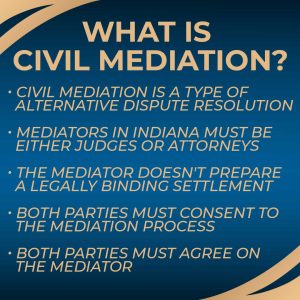
Civil mediation is a type of alternative dispute resolution that greatly differs from litigation, especially in family disputes. With mediation, you don’t present your case to a judge and jury in a courtroom. Instead, participants present their cases through a mediator, who is a neutral third party.
Mediators in Indiana can be either judges or attorneys. These individuals, serving as neutral lawyers, have a better understanding of Indiana law and legal rights, enabling them to use their knowledge and expertise to help parties agree to resolutions.
The mediator does not impose a legally binding settlement or resolution, as is the case with judges and arbitrators. Instead, the mediator will suggest proposals to resolve the conflict. The final decisions in resolving the conflict are up to you and the other party; clients are under no obligation to accept the mediation proposal.
While mediation is separate from litigation, a judge in a civil case may order parties to undergo the mediation process. Judges commonly want parties to attempt to fix disputes outside of court. You can also enter mediation without a court order. The only requirements are that both parties consent to the mediation process and agree on the mediator.
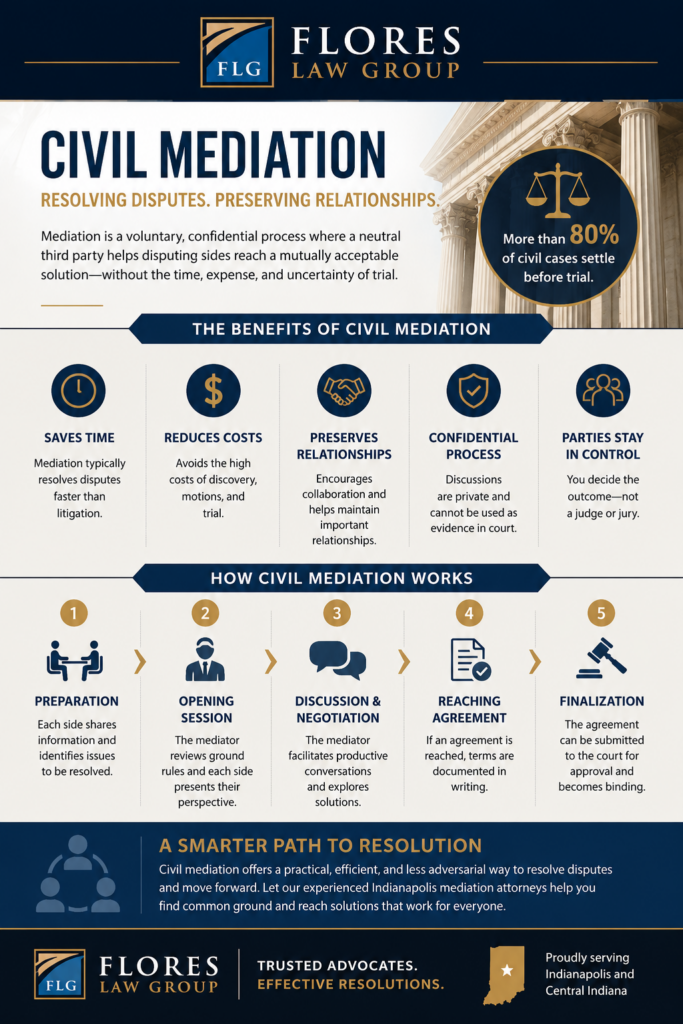
The primary benefit of choosing mediation over litigation is that it takes less time to prepare than a court trial and is more cost-effective for the lawyer and the client. Mediation also guarantees confidentiality. This allows parties to feel more comfortable voicing their feelings about the conflict, especially in mediation regarding sensitive family matters.
Types of Cases We Mediate
The Flores Law Group is trained in mediating cases involving:
Motor Vehicle Accidents:Traffic accidents can cause debilitating and costly injuries and property damage. Injured individuals and automotive insurance companies frequently have conflicts over liability and fair damages, leading to prolonged civil cases. A mediator can help bring the case to a close without a lengthy trial.
Premises Liability Civil Cases: Premises liability refers to a property owner’s responsibility to keep others safe on their property. If you or a family member suffers an injury due to a property owner’s negligence, you may be entitled to compensation. A trained mediator can work with the injured person and the alleged negligent party to assist them in reaching an agreement in a mediation environment.
Workers’ Compensation: Workers’ compensation insurance ensures benefits for employees who suffer injuries while on the job. Often, injured workers do not feel that they receive their fair share of benefits or a just settlement. A neutral third party can help resolve compensation disputes between injured employees and their employer’s insurer.
Enrique S. Flores, Jr. has extensive knowledge in these practice areas, since he’s also served as a personal injury and worker’s compensation lawyer for years in Indiana. He can assist disputing parties in deciding the best course of action to settle the conflict.
What Happens During Mediation
Before mediation sessions begin, the mediator will inform all participants that the proceedings are confidential. Confidentiality during the process prevents anything that is revealed in the mediation process from being used in the trial. Still, parties cannot use mediation to invalidate evidence that would otherwise be used in court.
Once the mediation process begins, the mediator will meet with participants. Each person will have the choice to make opening statements, often through legal counsel. From there, the mediator will separate the parties and their attorneys and discuss the case.
The Importance of Having a Lawyer Present
While nothing you say can be used against you in court, you should still be careful of what you discuss openly in the mediation sessions. It is best to have a lawyer with you, as attorneys have their clients’ best interests in mind. Your lawyer will advise you on what you should and should not discuss during the mediation process. You should also follow your attorney’s legal advice as they are trained in how to negotiate a more favorable resolution on your behalf.
Your mediation’s duration will depend on your unique case. Some concerns can be solved quickly within only a few hours, while others will require multiple mediation sessions over a few days.
Once again, you do not need to abide by the mediator’s suggested settlement. You can choose to negotiate or reject the proposal and enter or continue litigation.
Why Having a Bilingual Mediator Is Crucial
It’s fundamental for each party in the relationship to fully understand the case’s mediator and the proposed resolution. Opting for bilingual mediation services is critical for Spanish speakers, as both parties should be able to speak with the mediator directly rather than through a translator.
If Spanish is your first language, you should request a bilingual mediator.
Having a bilingual lawyer and mediator can also help clients prevent biases based on cultural and linguistic backgrounds. A mediator who struggles to communicate with one of the parties may unconsciously favor the English-speaking participant, as they can communicate with them directly. A bilingual mediator can navigate linguistic and cultural differences to help the parties reach an agreeable settlement.
The Flores Law Group provides bilingual mediation services. Attorney Enrique S. Flores, Jr. spent much of his life in Mexico and has the linguistic expertise to mediate cases in both English and Spanish.
Contact Flores Law Group for Indianapolis Mediation Services
If you have questions regarding mediation or are ready to enter the mediation process, set up a time to talk with the attorneys at Flores Law Group.
In 2026, is civil mediation confidential in Indiana, and can what I say in mediation be used in court later?
In general, Indiana’s ADR Rules treat mediation sessions as confidential and limit admissibility of mediation communications, with specific rule-based exceptions. Because exceptions and strategy can matter (for example, what gets put in writing, what is shared with the other side, and what is shared only with the mediator), it is smart to plan your mediation communications with counsel before the session.
How is a mediator chosen in an Indianapolis civil case, and what if we cannot agree on one?
If the court refers a civil case to mediation, the parties typically have 15 days to select a mediator from Indiana’s commission registry or agree to a non-registered mediator (with court approval). If the parties do not select a mediator in time, the court can appoint one under the ADR rules.
How much does civil mediation cost in Indiana, and who pays the mediator?
Mediation costs can vary, but Indiana’s ADR rules allow the parties to agree on costs and cost-splitting. If the parties do not agree, the court may set an hourly rate and determine how the costs are divided.
Does choosing mediation pause the statute of limitations or tort-claim notice deadlines in Indiana?
Not automatically. Indiana’s ADR Rule 8.8 specifically warns that participating in optional early mediation does not change filing deadlines under statutes of limitations or advance notice requirements, including notices required for claims against government units under the Indiana Tort Claims Act.
What should I bring to a civil mediation with an attorney in Indianapolis?
Bring key documents that support your position, such as contracts, invoices, photos, medical records, and a clear summary of damages, as well as a realistic settlement range. We help you prepare a short confidential mediation statement so the mediator understands the legal issues under Indiana law and the practical barriers to settlement. Arriving organized gives civil mediation the best chance to resolve your Indianapolis dispute efficiently.
Is a mediation agreement enforceable in Indiana and how is it documented?
Yes, when the parties reach a settlement in civil mediation, we draft a written agreement that states all essential terms with signatures by the parties and counsel. In Indiana practice, a signed mediation agreement can be enforceable like a contract and typically leads to a dismissal entry or agreed judgment filed with the court in Indianapolis. We make sure the attorney-prepared language covers payment timing, releases, contingencies, and what happens if someone fails to perform.
How do I decide whether to mediate now or keep litigating in Indianapolis?
We analyze liability exposure, likely verdict ranges under Indiana law, litigation costs, insurance issues, and your business or personal priorities. If the data favors a negotiated solution, we will recommend civil mediation and build a strategy that maximizes leverage while keeping lines of communication productive. If you want to talk through options with an experienced Indianapolis attorney team, please reach out to Flores Law Group for guidance tailored to your case.
Additional Information in Indianapolis, Indiana
Mediation Basics from the ABA: A clear, plain-English overview of what mediation is, how it differs from trial, and the mediator’s role. It walks through preparation, confidentiality, and what to expect in the room. Great primer for first-time participants in civil mediation. Helpful context before meeting with your Indianapolis attorney.
Lawyer-Mediators and Ethics Opinion 518: Practical takeaways from ABA Formal Opinion 518 on how attorneys should communicate in mediation. Explores neutrality, candor, and what is permitted when discussing settlement. Useful for setting expectations with counsel and the mediator. Helps parties understand ethical guardrails that shape the process.
Indianapolis Tort Claim Filing Guide: Step-by-step instructions for submitting a tort claim to the City of Indianapolis or Marion County. Explains eligibility, deadlines, and the information you must include. Points you to the correct forms and filing addresses. Essential if your civil dispute involves potential claims against local government.
Practice Areas
Contact us
Call a Lawyer Today
Accidents can happen at any time, whether on the way to the store or while at work. These accidents can often lead to serious injuries. Injured individuals are often at a loss when dealing with insurance companies, especially when their lives have been changed permanently. Our office fights for the rights of those affected by workplace accidents or accidents caused by the negligence of others. We will help you navigate your claim and help you understand your rights from the first phone call. Contact us today for a Free Consultation.
By submitting this form and signing up for texts, you consent to receive informational text messages regarding case details, document requests, intake follow-ups, status updates, and appointment reminders from Flores Law Group, LLC at the number provided, including messages sent by an autodialer. Consent is not a condition of hiring our firm. Message and data rates may apply. Message frequency varies. Unsubscribe at any time by replying STOP. Reply HELP for help. Mobile information will not be shared with third parties/affiliates for marketing/promotional purposes. Privacy Policy | Terms & Conditions